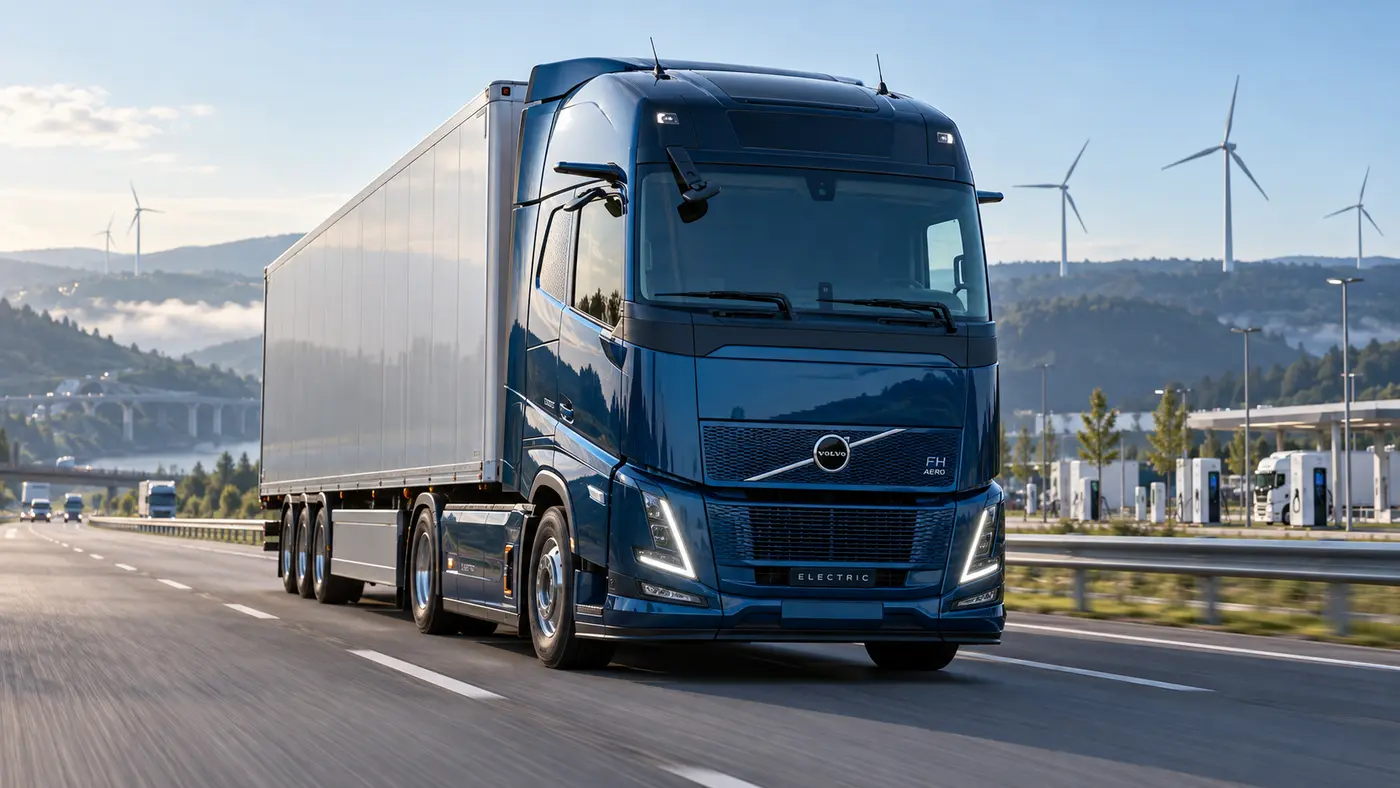
Volvo Trucks has started series production of its latest heavy-duty electric range, led by an extended-range FH Aero Electric with a claimed maximum range of up to 700 kilometres (about 435 miles) on one charge. The first trucks have left the production line at Tuve in Gothenburg, with production also planned in Ghent.
For UK fleets, the important change is not simply another large range number. Volvo has moved the technology from launch announcement to factory production, combining eight batteries with an e-axle and megawatt charging. That makes it a real procurement conversation for more long-haul and hub-to-hub routes, although it does not remove the need for route modelling, a workable charging site and a precise payload calculation.
What has entered production?
The headline vehicle is the Volvo FH Aero Electric with extended range. Volvo says its compact e-axle integrates two motors and a six-speed gearbox into the rear axle. Moving the driveline components frees chassis space for more batteries, allowing the truck to carry eight packs.
Volvo quotes up to 460 kW (623 hp), operation at up to 48 tonnes gross combination weight and payload of up to 28 tonnes. Those are specification-dependent manufacturer figures, not a guarantee for every tractor, trailer and operating weight. The production programme also includes the next-generation FH, FM and FMX Electric models, which Volvo quotes at up to 470 km range for regional, construction, refuse and specialist applications.
The wider electric range received the International Truck of the Year 2027 award in September. Awards are useful evidence of technical progress, but they do not replace a duty-cycle trial or a written whole-life cost comparison for the fleet buying the truck.
What the 700 km figure really means
Seven hundred kilometres is a maximum claimed range. Volvo states that weather, wind, total vehicle weight and the way the truck is driven can all change the result. Motorway speed, hills, winter heating, refrigeration and available battery reserve can also affect how much of that figure is usable in daily work.
A sensible buying exercise starts with the diesel route data rather than the brochure. Pull several months of telematics for the vehicle being replaced and record:
- daily and weekly mileage, including the longest unplanned diversions
- gross weight, payload and trailer type on each leg
- time spent at the depot, customer sites and statutory breaks
- seasonal effects, auxiliary loads and overnight parking arrangements
- the minimum reserve needed when a charger is occupied or unavailable
Ask the supplying dealer to model the exact truck against those routes in winter and summer. A route that comfortably fits inside the working range is a stronger candidate than one that depends on achieving the maximum every day.
MCS and CCS give two different charging plans
Volvo quotes a 20–80% charge in about 50 minutes using 700 kW Megawatt Charging System equipment. On a 350 kW Combined Charging System connection, the same 20–80% window is quoted at about 85 minutes.
Those times show why the extended-range truck is aimed at long-haul work: a suitable MCS stop could fit around a scheduled driver break. But the truck’s capability does not create a 700 kW supply at the depot. The operator must confirm the grid connection, charger specification, planning and civil works, software, maintenance cover and how several vehicles will share the available power.
Before signing a vehicle order, obtain a timed infrastructure plan and an energy-cost model. Include network standing charges, peak-demand limits, charger losses and a fallback for outages. If public MCS is part of the route, verify that the location, access rules and opening date are firm enough for the transport contract.
Payload must be checked on the finished truck
The e-axle creates room for extra batteries, but more stored energy still has a weight and cost. Volvo’s quoted payload of up to 28 tonnes applies to a particular configuration. Cab choice, wheelbase, fifth wheel, batteries, tanks, driver equipment, trailer and optional systems all influence the final unladen weight and axle loads.
Request a written weight calculation for the exact UK specification, then compare it with the diesel unit on the same trailer. If the route normally cubes out before it weighs out, the difference may be unimportant. If the operation regularly runs close to legal axle or gross limits, every kilogram should be priced into the business case.
The right comparison is cost per productive journey, not simply purchase price or maximum range. Our guide to choosing between diesel and electric trucks sets out the wider duty-cycle questions.
Refrigerated and two-shift work may be relevant
Volvo says the truck can provide an electric power take-off for refrigeration, avoiding a separate diesel generator. It also positions the higher charging rate for hub-to-hub and two-shift operations.
Both uses need detailed energy planning. A fridge consumes energy that might otherwise move the truck, while a second shift reduces the time available for slow depot charging. Ask for a simulation that includes the body or trailer equipment, loading time and the real gap between drivers, not only the tractor’s road consumption.
What UK grant support could apply?
Current GOV.UK guidance lists several Volvo FH and FM electric configurations among eligible zero-emission trucks. For trucks over 26 tonnes, the maximum discount is the lower of £81,000 or 40% of the vehicle’s upfront cost in England, Scotland and Wales. Different percentage limits can apply to large enterprises in Northern Ireland. The seller includes an approved discount in the purchase price.
The list names configurations, not every possible version of a model family. Do not assume that the new extended-range FH Aero specification is automatically covered because another FH Electric appears on the list. Ask the dealer to confirm the exact variant, completion status and grant amount in writing before using the discount in a finance proposal.
Questions to ask before ordering
- When can the exact right-hand-drive UK specification be ordered and delivered?
- What range is predicted on our own routes at our normal weights in winter?
- What is the finished unladen weight and payload with our cab, fifth wheel and options?
- What battery capacity is usable, and what battery and driveline warranties apply?
- Can the truck sustain the quoted charging rate through the planned stop?
- What grid, charger and civil work must be completed before the truck arrives?
- Is this exact variant on the current UK grant list, and what discount is confirmed?
- Which workshops and recovery providers can support the high-voltage vehicle on our routes?
Series production is the meaningful part of this announcement. Volvo’s 700 km FH Aero Electric takes long-haul battery trucks another step from trial fleets towards normal ordering, but it should still be bought as a complete transport system: truck, trailer, route, charger, grid connection and support package.
For a structured way to compare the specification, read the new-truck figures that matter. You can also browse trucks currently advertised on Trucksalot or explore commercial vehicle finance through DCF.