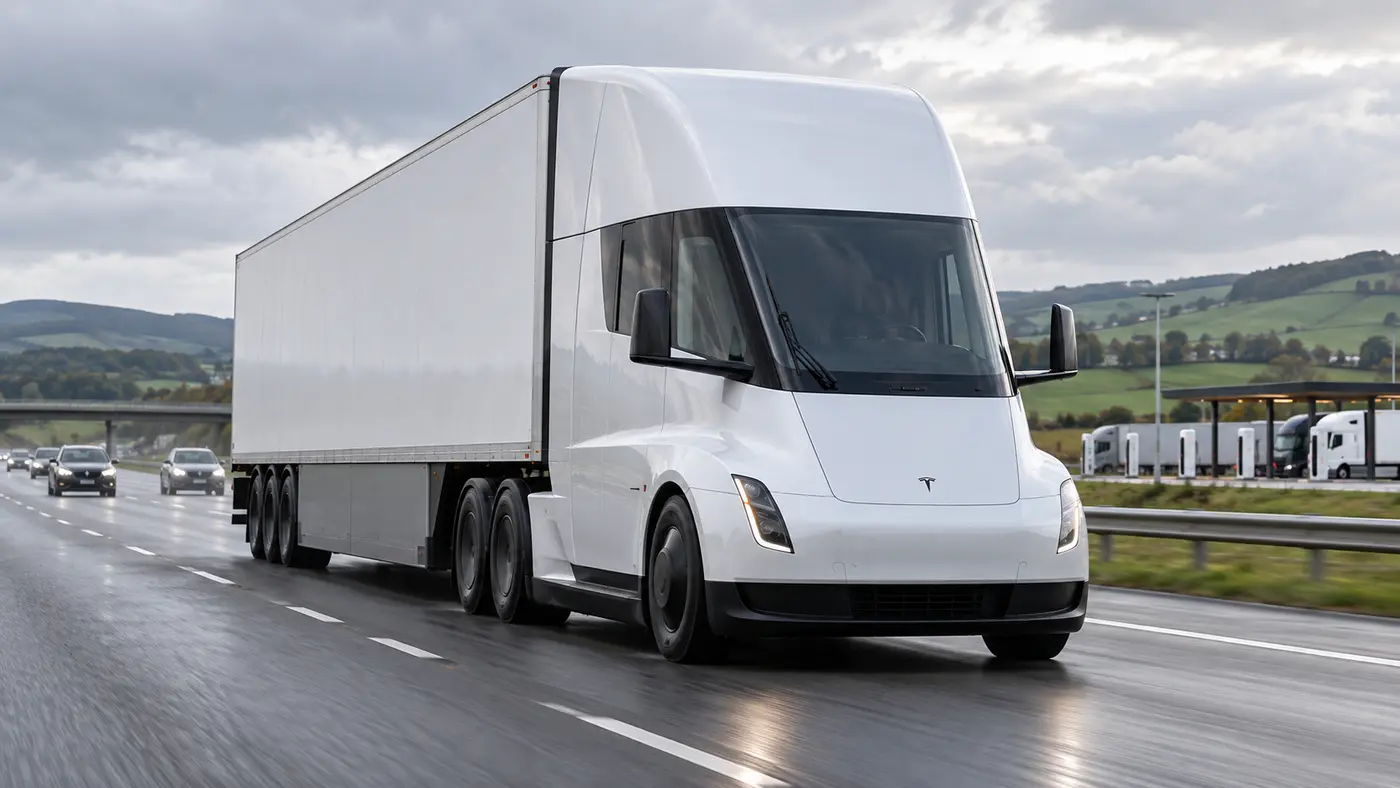
Tesla plans to begin delivering the Semi to European customers in 2027. The timing was confirmed at IAA Transportation in Hanover, where Tesla’s head of Semi, Dan Priestley, presented the truck and outlined its move into Europe.
That puts a new name into the European heavy-truck market, but it does not yet make the Semi a straightforward UK buying decision. Tesla has published useful figures for the truck and its charging hardware, while UK-specific pricing, right-hand-drive availability, dealer and workshop coverage, final homologated weights and grant status still need to be confirmed.
What Tesla has confirmed for Europe
IAA Transportation reported on 15 September 2026 that first European customer deliveries are scheduled for 2027. Tesla’s current Semi material separates the truck into Standard Range and Long Range versions, and its fleet enquiry form asks operators to choose between those two trims.
Tesla says the Long Range truck can cover up to 500 miles, while the Standard Range version is positioned at about 325 miles. It also quotes energy use of less than 2 kWh per mile and says its Megacharger can add up to 60% of range in 30 minutes. These are manufacturer figures, not a prediction for every UK duty cycle.
Do not convert the maximum range straight into a route plan
A 500-mile headline range is roughly 805 kilometres, but the usable figure will depend on the European specification, gross weight, speed, topography, weather, auxiliary loads and the battery reserve required at the end of a shift. A long-distance trunk route may also need enough margin for diversions, queueing and a charger being occupied or unavailable.
Before comparing the Semi with a diesel tractor or another electric truck, export at least several months of telematics from the vehicle it could replace. Record:
- daily mileage and the longest regular route, not only the average
- gross and axle weights on outbound and return legs
- motorway speed, hills, urban running and seasonal traffic
- refrigeration, hydraulics or other power-consuming equipment
- depot dwell time, driver breaks and customer-site waiting time
- the reserve needed when the preferred charger cannot be used
Ask Tesla to model the exact European truck against this data in winter and summer. Compare productive journeys per week with an agreed reserve, not the longest distance achieved in favourable conditions.
Charging is part of the vehicle specification
Tesla’s commercial charging page describes a Megacharger post rated at up to 1.2 MW. One cabinet can provide up to 1,200 kW shared between two posts, while each post serves one truck. Tesla also lists a 120 kW Basecharger for longer dwell periods. Both are shown as using MCS 3.2 and supporting ISO 15118-2 and OCPI-capable communications.
A truck capable of megawatt charging does not create a megawatt grid connection. A two-post cabinet may also share its maximum output when two trucks plug in together. Depot design must reflect arrival times, charging curves and simultaneous demand.
Obtain a separate, timed infrastructure proposal before ordering trucks. It should cover the grid connection, charger and civils, planning, cable routes, transformer and switchgear, load management, software, maintenance response and a fallback for outages. The cost model should include standing charges, peak power, charging losses and any public charging used away from base.
The government’s Depot Charging Scheme can support eligible UK projects. Current policy says businesses and public authorities may receive up to £1 million, covering up to 70% of qualifying infrastructure cost, but verify the rules and application window before treating funding as committed.
Payload and axle loads need a UK answer
Great Britain generally permits a six-axle articulated combination to operate at up to 44 tonnes when the relevant conditions are met. GOV.UK also makes clear that the manufacturer and ministry plates, individual axle limits, gross weight and train weight must all be respected. Operating above 44 tonnes is normally limited to special circumstances.
This makes the finished UK kerb weight and axle layout more important than a global power or range claim. Battery capacity, cab design, wheelbase, fifth wheel position and trailer choice all affect payload and axle distribution. The operator needs a written weight calculation for the precise UK tractor and its normal trailer.
Ask for front- and drive-axle loads with a driver, fluids and equipment included, then model the loaded trailer. If the business regularly reaches 44 tonnes or works close to an axle limit, a small difference in tractor weight can change the number of journeys or the revenue payload. Our guide to tractor-unit axle layouts explains why the headline gross figure is only part of the calculation.
UK grant eligibility is not yet a safe assumption
The UK Zero Emission Truck Grant currently offers up to £81,000 for eligible trucks over 26 tonnes, limited to 40% of the upfront cost in England, Scotland and Wales and for qualifying SMEs in Northern Ireland. Large Northern Ireland enterprises have a 30% percentage limit.
However, the live eligible-vehicle list names specific DAF, IVECO, MAN, Mercedes-Benz, Renault Trucks, Scania and other models; it does not currently list the Tesla Semi. Eligibility can change, but a buyer should not include a grant in the finance case until the exact UK variant appears on the official list and the seller confirms the deduction in writing.
Support coverage may be as important as range
An electric tractor used on trunk work needs high-voltage recovery, parts and diagnostic support on the routes it serves. Tesla’s passenger-car network does not by itself answer who will recover a loaded articulated vehicle, where it can be repaired, what mobile support is available or how quickly a damaged charging connector can be replaced.
Before placing a deposit, request named UK service locations, opening hours, technician coverage, roadside response targets, parts stocking and a process for trailer separation and vehicle recovery. Check the battery, driveline and whole-vehicle warranties, including exclusions linked to charging behaviour, annual mileage and maximum operating weight.
The questions a UK operator should ask now
- Will a right-hand-drive version be offered in 2027, and when can UK orders be placed?
- What are the homologated axle, gross and train weights for the UK tractor?
- What payload remains with our trailer, driver and normal equipment?
- What range does Tesla predict on our routes at our real weights in winter?
- What charging rate can the truck sustain, rather than briefly peak at?
- How is 1.2 MW shared when both Megacharger posts are occupied?
- Which UK workshops and recovery providers will support the truck?
- What is included in the vehicle, battery and charging-equipment warranties?
- Will the exact version qualify for the UK truck grant?
- What are the vehicle, charger and grid-connection delivery dates?
The Tesla Semi’s 2027 European delivery plan is significant because it adds another serious entrant to the electric tractor market. For UK buyers, the correct next step is structured due diligence: prove the route, payload, charging and support case before pricing the finance. Read our wider guide to choosing between diesel and electric trucks, then browse trucks currently advertised on Trucksalot or explore commercial vehicle finance through DCF.