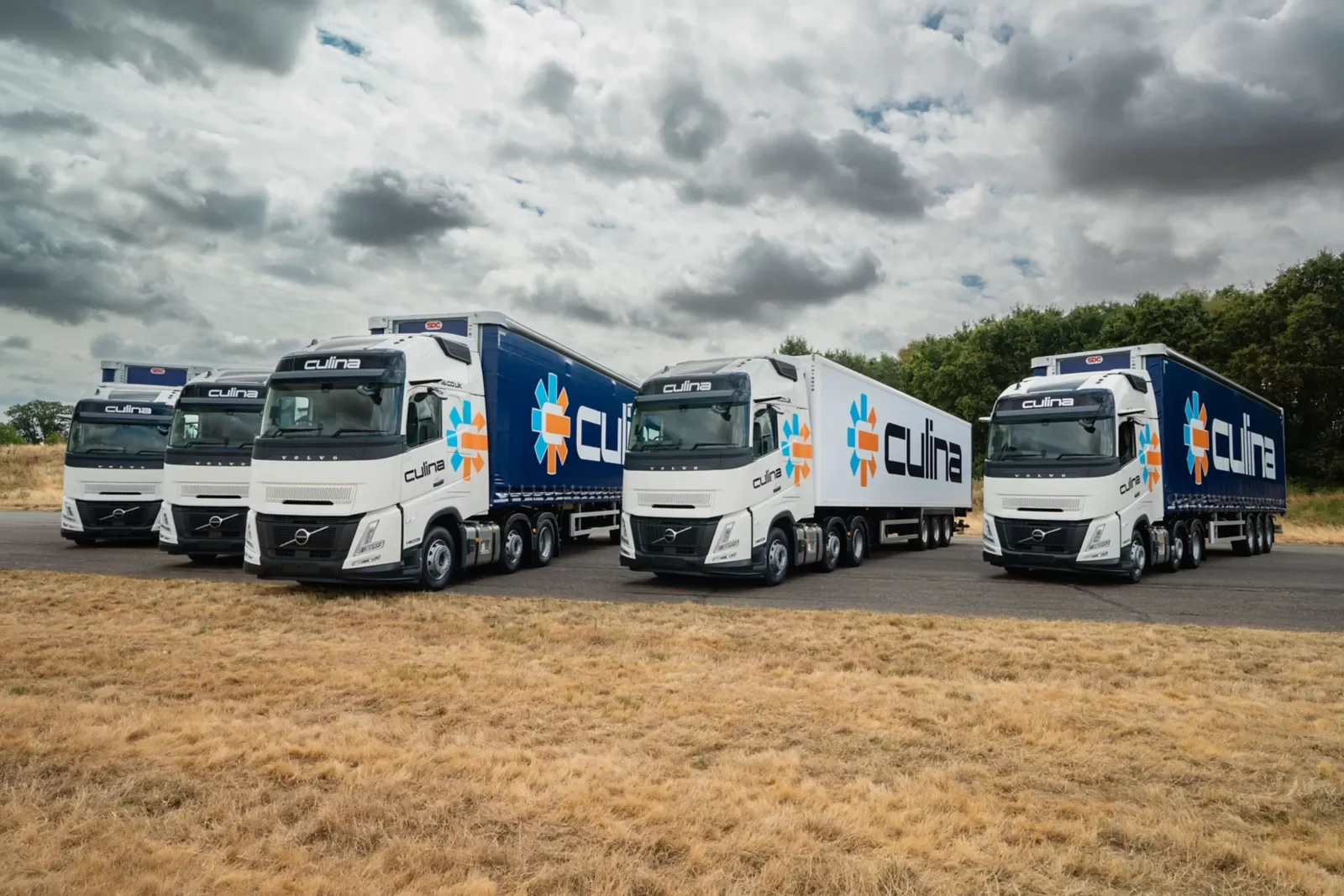
Culina Group has ordered 1,051 Volvo FH Aero 6×2 tractor units for its UK fleet, one of the largest single fleet-renewal announcements in the British truck market this year. The vehicles will enter service in stages, with Culina expecting the full order to be operating by summer 2027.
The scale makes the order newsworthy, but the specification is more useful to working operators. Culina is buying diesel tractor units for intensive national distribution after running 134 Volvo FHs introduced in 2024. Volvo says the new trucks may cover between 150,000 and 260,000 km a year, seven days a week. That is the kind of utilisation at which small differences in fuel use, downtime and driver acceptance can become large fleet costs.
What exactly has Culina ordered?
The order covers 1,051 Volvo FH Aero 6×2 tractor units. Volvo says they use Euro 6 D13TC Step E engines with turbo-compound technology, its 12-speed I-Shift automated gearbox and I-See predictive cruise control. Camera Monitoring System equipment replaces conventional exterior mirrors.
The manufacturer has not published every detail of Culina's final specification in its announcement, including the power rating, axle arrangement within the 6×2 family or cab options. Buyers should avoid assuming that a fleet headline describes a standard off-the-shelf truck. A 6×2 tag still leaves choices around pusher or tag axle, suspension, fuel capacity, wheelbase, fifth-wheel position and finished kerb weight.
If you are comparing vehicles for similar work, read our guide to tractor-unit axle layouts and browse the current tractor units for sale on Trucksalot.
Why the FH Aero appealed to a high-mileage fleet
Culina says the decision followed positive operating results from the 134 Volvo FH tractors added to its fleet in 2024. Volvo describes the FH Aero as capable of reducing energy use and emissions by up to 5% through its more aerodynamic cab and related vehicle technology.
That figure is a manufacturer claim, not a guaranteed saving for every route. The commercial significance is that Culina has tested earlier FH vehicles in its own work before committing at scale. For another operator, the correct lesson is not simply to buy the same badge. It is to create a controlled trial using representative trailers, loads, routes and drivers before multiplying a brochure percentage across a replacement plan.
The D13TC uses an additional turbine after the turbocharger to recover energy from the exhaust and return torque to the crankshaft. Volvo's current FH Aero specifications list I-Save ratings up to 500 hp and 2,800 Nm, although the exact rating selected by Culina was not stated. I-See uses road-topography information to help manage speed and gear strategy, while I-Shift handles the gear changes.
What a claimed 5% saving could mean
At fleet scale, the calculation becomes substantial. If a tractor uses 45,000 litres of diesel a year, a genuine 5% reduction would equal 2,250 litres. Across 1,051 trucks that would be about 2.36 million litres a year. That is an illustration, not a forecast for Culina: actual consumption, mileage and achieved improvement have not been published.
Operators should build the comparison from their own fuel records. Use litres per 100 km or mpg for equivalent work, then separate the effect of the replacement truck from changes in load, trailer, route, traffic, tyres, idling and driver. Measure AdBlue as well as diesel, and include any difference in payload or maintenance cost.
A saving that looks modest per vehicle can justify a higher purchase price on high annual mileage. The same premium may be hard to recover on a low-mileage tractor, a vehicle kept as spare capacity or work dominated by waiting and power take-off use.
Camera mirrors: efficiency is only part of the decision
The order includes Volvo's Camera Monitoring System. Removing large mirror housings can reduce aerodynamic drag, but the operator case also covers visibility. Volvo says the system widens the driver's view and can pan to follow the rear of the trailer during a turn.
Before specifying camera mirrors, ask drivers to use them in darkness, rain, low winter sun, tight yards and coupling work. Confirm what happens if a camera or display is damaged, where replacement parts are held and whether the workshop can diagnose faults quickly. A feature that saves fuel but leaves a vehicle waiting for a part can lose its advantage.
Training matters too. Drivers accustomed to glass mirrors need time to learn the screen position, depth cues and available display modes. Record feedback during a trial rather than waiting until the whole order arrives.
Uptime cover and finance are part of the specification
Volvo says Culina's trucks are being supplied through Volvo Financial Services and covered by Volvo Gold Contracts. For trucks expected to run every day and potentially exceed 200,000 km a year, the support package is not a footnote. Planned maintenance slots, roadside response, workshop capacity and replacement-vehicle arrangements can affect the cost per kilometre as much as a headline equipment option.
When comparing a manufacturer package with an independent finance and maintenance structure, put the same items on both sides: deposit or initial rental, term, balloon or residual assumptions, mileage limits, maintenance inclusions, tyre policy, roadside support, exclusions and end-of-term condition. The cheapest monthly figure is not necessarily the lowest-cost working truck.
For a smaller operator, concentration risk also matters. A large fleet can spread a model across depots and keep workshop knowledge in-house. An owner-driver or ten-truck business may need stronger evidence about local dealer capacity and parts availability because one vehicle off the road represents a larger share of revenue.
Five questions UK operators should take from the Culina order
- Has the truck been proved on our work? Run a meaningful demonstration against a current vehicle, using comparable loads and routes.
- What is the finished specification? Confirm axle layout, fifth-wheel position, tanks, cab, safety equipment, kerb weight and trailer compatibility in writing.
- How will the saving be measured? Agree the baseline, time period and data source before the trial begins.
- Can the support network match the utilisation? Check workshop hours, mobile support, parts stock and recovery arrangements at every operating base.
- Does the whole-life cost work at our mileage? Model fuel, AdBlue, maintenance, tyres, finance, downtime and residual value using conservative assumptions.
What the order may mean for the used-truck market
A renewal of this size will eventually take older vehicles out of front-line service. That does not mean more than a thousand used tractors will appear at once: deliveries are phased, and outgoing vehicles may be sold through several channels or retained for other duties.
Used buyers should watch for well-maintained fleet tractors with documented mileage and service records, but inspect duty history rather than relying on livery or age. High annual mileage is not automatically a reason to walk away if maintenance has been disciplined; equally, a full contract does not remove the need to check condition, fault history, tyres, brakes, emissions systems and remaining test.
Our new-truck buying checklist helps structure a replacement decision, while Trucksalot's Volvo trucks for sale page shows current advertised stock.
The practical takeaway
Culina's order is a strong vote for diesel FH Aero tractor units in intensive UK distribution, but its real value is the buying process behind it: trial a manageable batch, measure performance in real work, then scale only when the numbers and support package stand up.
For UK operators planning a renewal, the badge is the final line of the decision rather than the first. Start with the route, load, annual mileage and downtime exposure; specify the truck around those facts; and make every fuel or uptime claim measurable before signing the order.